

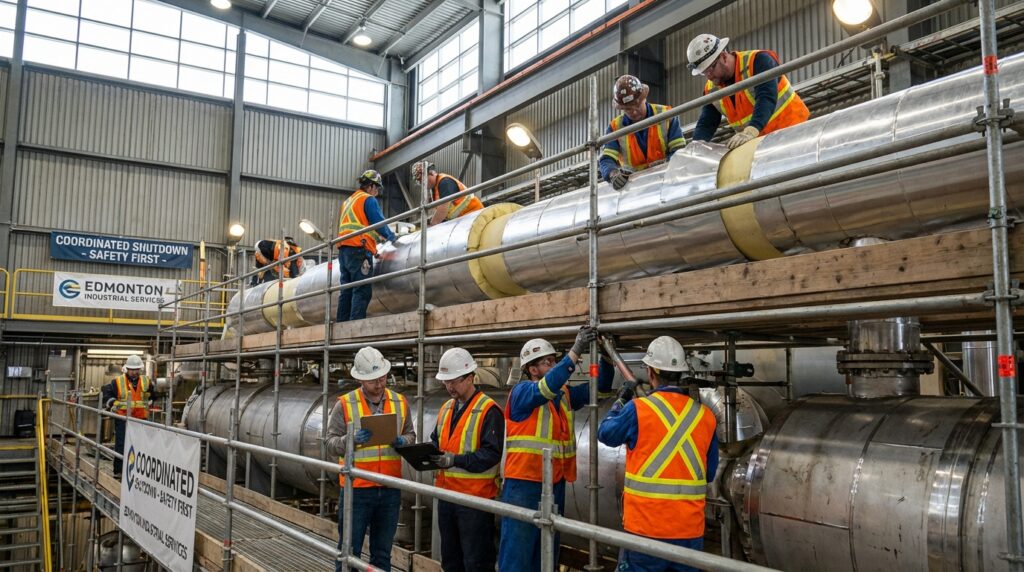
Plant turnarounds and shutdowns are some of the highest-stakes events on an industrial facility’s calendar. A refinery, chemical plant, or power station might spend a year planning a three-week outage, only to see schedules slip and budgets balloon because the wrong contractor walked through the gate. Choosing the right shutdown (TA) contractors isn’t just a procurement task — it’s a risk management decision that affects safety, schedule, and the bottom line.
This guide walks through what you actually need to know before you sign a contract: which trades show up during a turnaround, how to separate qualified crews from the rest, how to write an RFQ that gets you comparable bids, and the red flags that should make you walk away. Whether you’re a turnaround manager, a maintenance planner, or a procurement lead doing this for the first time, this guide will help you build a shortlist you can trust.
The Trades You’ll Need: Mapping Out a Turnaround Workforce
A shutdown rarely involves a single contractor. Most turnarounds are staffed by a coalition of specialty trades, each brought in for a defined scope and window. Understanding these categories helps you scope your RFQs correctly and avoid gaps in coverage.
Mechanical contractors form the backbone of most turnarounds. This covers vessel and exchanger work, piping tie-ins, valve overhauls, pump and compressor maintenance, and tower internals replacement. Mechanical crews are typically the largest workforce on site and the ones most likely to be on the critical path, so their crew size, supervision ratio, and tooling availability deserve close scrutiny.
Scaffolding contractors build and dismantle the access structures that every other trade depends on. A weak scaffolding contractor can quietly become your biggest schedule risk, because mechanical, insulation, and NDT crews can’t start until scaffold is certified and tagged. Ask about their erection rate (square feet or units per day), their inspection and tagging process, and whether they use a digital scaffold management system.
NDT (non-destructive testing) providers handle inspection work — UT thickness testing, radiography, magnetic particle testing, PMI (positive material identification), and increasingly, drone or robotic inspection for hard-to-access areas. Because NDT results often determine whether equipment is fit for service, certification of technicians (ASNT, PCN, or equivalent) matters as much as the equipment itself.
Electrical and instrumentation contractors cover motor work, switchgear maintenance, instrument calibration, and control system tie-ins. These crews often work in parallel with mechanical trades but need tight coordination on lockout/tagout (LOTO) and energized equipment isolation.
Insulation and refractory contractors strip and reinstall thermal insulation and fireproofing, and handle refractory repair in furnaces, boilers, and reactors. This trade is frequently underestimated in planning but can become a bottleneck if insulation removal isn’t sequenced properly with mechanical work.
Beyond these five core categories, larger turnarounds may also need crane and heavy-lift contractors, industrial cleaning and vacuum truck services, catalyst handling specialists, and welding/fabrication shops. Mapping your full scope against these categories before you start sourcing prevents the common mistake of discovering a coverage gap mid-outage.

Key Qualification Criteria: What Separates Qualified Contractors From the Rest
Once you know which trades you need, the harder question is how to tell a genuinely qualified contractor from one that simply has a sales team good at filling out forms. Three areas deserve the most weight.
Safety record
Safety performance is the single best predictor of how a contractor will perform under turnaround pressure, because shutdowns compress timelines and increase the number of simultaneous high-risk activities on site. At minimum, request:
- TRIR (Total Recordable Incident Rate) and LTIR (Lost Time Incident Rate) for the past three years
- EMR (Experience Modification Rate) from their workers’ comp carrier
- Any OSHA citations, especially willful or repeat violations
- Site-specific safety statistics if they’ve worked turnarounds at comparable facilities
A single bad year isn’t automatically disqualifying — ask about what changed afterward. A contractor who can explain a corrective action plan in detail is often more trustworthy than one with a spotless record and no story to tell.
Experience and track record
Generic industrial experience doesn’t always translate to turnaround experience. Look specifically for:
- Number of turnarounds completed in the last 2–3 years, and at what scale (crew size, duration)
- References from facilities similar to yours in process type (refining, petrochemical, power, pulp and paper, etc.)
- Familiarity with your specific equipment types, codes, and standards (API, ASME, NBIC)
- Whether they’ve worked under your EPC or owner’s TA management framework before
Ask references pointed questions: Did the contractor hit their planned productivity rates? How did they handle scope growth or schedule compression? Would the reference rehire them for the next outage?
Workforce size, sourcing, and scalability
Turnarounds often require a contractor to scale from a baseline crew to several times that size for a few weeks, then scale back down. Ask how they plan to staff the peak period — direct hires, traveling craft, subcontracted labor, or a mix — and how they verify the qualifications of workers brought in on short notice. A contractor that can’t clearly explain their staffing plan for peak week is a contractor that will be improvising during your outage.
Other qualification factors worth checking: bonding and insurance limits, financial stability (a contractor’s financial distress mid-turnaround is a real and underappreciated risk), equipment ownership versus rental dependency, and union or labor agreement status if relevant to your site.
How to Structure an RFQ/RFP for Turnaround Work
A vague RFQ produces vague, incomparable bids. The goal of a well-structured RFQ is to make every contractor bid against the exact same scope, assumptions, and evaluation criteria, so you’re comparing apples to apples.
1. Define scope with precision. List specific work packages, equipment tag numbers where applicable, estimated quantities (linear feet of pipe, number of valves, square footage of scaffold), and any known scope contingencies. Vague line items like “general mechanical support” invite wildly different interpretations and bids.
2. Specify the schedule and milestones. Include the outage window, key milestone dates, expected crew ramp-up and ramp-down curve, and any sequencing constraints driven by other trades.
3. Set qualification requirements up front. State minimum safety statistics, required certifications, insurance minimums, and any prequalification documentation you require before a bid will even be considered. This filters out unqualified bidders before you waste time evaluating their pricing.
4. Standardize the pricing format. Whether you want unit-rate pricing, lump sum, or a hybrid, specify it clearly and provide a template. Ask for a breakdown of labor rates by craft and level, equipment rates, and markup structure, so you can sanity-check the numbers rather than just comparing bottom lines.
5. Address contingency and change order terms. Turnaround scope almost always grows once the unit is opened up. Ask bidders how they price added scope, how quickly they can mobilize additional crew, and what their change order approval process looks like.

6. Require a staffing and execution plan. Ask for an organization chart, named key supervisory personnel, and a narrative of how they intend to execute the work — not just a price.
7. Build in a clarification period and a walk-down. A site walk and a structured Q&A period before bids are due reduces the number of post-award disputes about what was actually included in scope.
A well-built RFQ takes more time up front, but it pays for itself many times over in reduced disputes, fewer change orders, and bids you can actually compare side by side.
Red Flags to Watch For When Hiring TA Contractors
Even with a solid RFQ process, certain warning signs should prompt deeper scrutiny or an outright pass:
- Bids that are dramatically lower than the rest of the field. Underpricing is one of the most common precursors to scope disputes, change-order padding, or a contractor cutting corners on staffing once the work starts.
- Reluctance to share safety statistics or references. Qualified contractors are generally proud of their numbers. Hesitation is itself information.
- High turnover in key supervisory roles. If the named superintendent or general foreman has changed multiple times in recent projects, continuity during your outage is at risk.
- Heavy reliance on last-minute subcontracted or temporary labor without a clear vetting process. This is especially risky for trades like NDT and scaffolding where certification matters.
- No clear LOTO, confined space, or hot work procedures specific to turnaround conditions. Generic safety plans that haven’t been adapted to your site and outage conditions suggest the contractor hasn’t actually planned for your job.
- Unwillingness to commit to named personnel in the contract. Vague staffing promises (“we’ll assign someone qualified”) often become a problem once the contract is signed and crews are scarce industry-wide.
- Financial instability signals, such as recent layoffs, unpaid supplier disputes, or difficulty securing bonding — all of which can surface mid-turnaround in the worst possible way.
None of these are automatically disqualifying on their own, but two or more together should trigger a harder look before you sign.
The Role of a Contractor Prequalification Database
Doing all of the above — safety audits, reference checks, financial reviews, document collection — from scratch for every trade, on every turnaround, is enormously time-consuming. This is the gap that a contractor prequalification database is built to close.
A good prequalification platform centralizes the documentation buyers need (safety statistics, certifications, insurance certificates, references, equipment lists) in one place, and keeps it current so you’re not chasing paperwork in the final weeks before an outage. It lets you filter contractors by trade, region, certification, and safety performance, so you can build a shortlist in hours instead of weeks. And because listed contractors are typically reviewed or vetted to some baseline standard before inclusion, a directory gives you a faster, more reliable starting point than a cold search or word-of-mouth alone — while you still do your own diligence on safety records, references, and fit for your specific scope.
For turnaround managers running multiple outages a year across multiple sites, this kind of centralized resource turns contractor sourcing from a recurring fire drill into a repeatable process.
Find Your Next Turnaround Partner
Choosing the right mix of mechanical, scaffolding, NDT, electrical, and insulation contractors is one of the highest-leverage decisions in turnaround planning. The criteria above — safety record, real experience, workforce scalability, a rigorous RFQ process, and a sharp eye for red flags — give you a framework for making that decision with confidence rather than guesswork.
Browse prequalified shutdown and turnaround contractors in our directory to start building your shortlist today, filter by trade and region, and compare safety records and credentials side by side before you issue your next RFQ.
Leave a Reply